Colorado Financial Literacy Standards and Mandates
The American Public Education Foundation (APEF) issues a “report card” biennially that awards each U.S. state, DC, and Puerto Rico a grade for its K-12 financial literacy education policies. The fourth edition of the Nation’s Report Card on Financial Literacy – titled “Empowering Tomorrow’s Generation” – launched in September 2025. The state-level grades are based on currently available statewide requirements, standards, and curriculum for teaching personal finance in schools.
The report card distinguished Colorado with an “A” grade for its financial literacy education standards and mandates in 2025. The foundation’s reasoning was that the state has financial literacy standards in place for all of grades K-12; offers schools a financial literacy resource bank and newsletter; and, most importantly, requires completion of a financial literacy course for high school graduation.
The Centennial State’s financial literacy education benchmarks were adopted in 2008 after passage of HB08-1168, which mandated that the board of education should include standards for financial literacy in the process of revising and adopting the state content standards. In 2025, the CO General Assembly took this legislation to the next level by passing HB25-1192, the “Financial Literacy Graduation Requirement Act” for Pre- and K-12 schools, which was signed into law in May of that year. The bill sets a mandate for students to complete a course that incorporates all the state financial literacy standards in order to graduate from high school. The policy also requires that, during their graduation year, all students must be exposed to federal financial aid eligibility tools and net price calculators; and practice filling out a free application for federal student aid or the Colorado application for state financial aid. This legislation goes into effect during the 2027-2028 school year.
The Colorado Academic Standards Board published a document titled Personal Financial Literacy Expectations: Addendum to Social Studies and Mathematics Standards in December 2008. These standards require implementation of age-appropriate financial literacy instruction in all grade levels K-12, across four main areas: 1) Goal-setting, Financial Responsibility, and Careers; 2) Planning, Income, Saving, and Investing; 3) Using Credit; and 4) Risk Management. The APEF considers these standards adequate to ensure that Colorado students are exposed to financial literacy concepts throughout their entire school careers.
The Colorado board also maintains a resource bank of financial literacy-related materials that is currently available on the state Department of Education website. These resources include the state standards, information with links to state and national financial literacy programs, a monthly newsletter, and ways to get involved in financial education.
A Thorough Look at Pending or Recent Colorado Legislation Will Be Coming Soon
Recommended Policy for CO Financial Literacy Programs
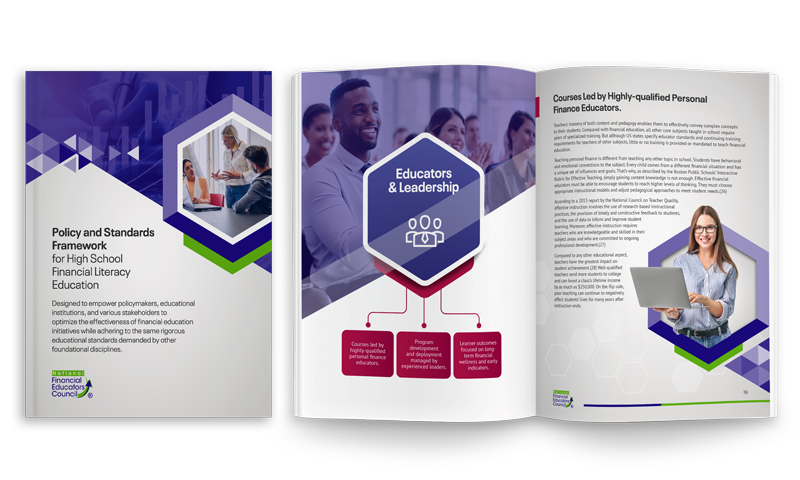
To address the gap in standards for personal finance education, the National Financial Educators Council has developed a set of benchmarks for all grade levels, K-12. This policy guide offers legislators a framework that standardizes educational quality and learner outcomes to provide the best possible financial education for American youth.
The Standards Guide is based on the notion that financial education should be treated with the same rigor as any other topic taught in schools and that all students should be capable – at minimum – of making near-term financial decisions.
National Standards for Financial Education
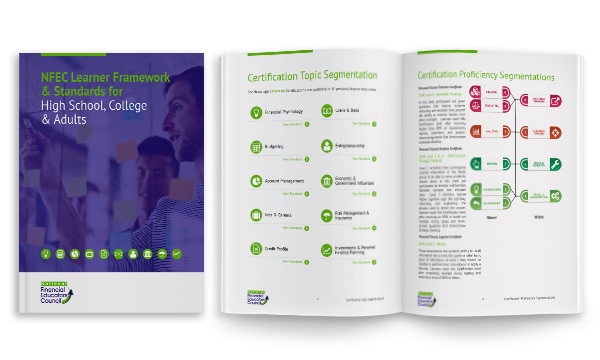
Financial Literacy Standards for Older Youth & Adults (High School through Adults)
Although there is no direct mandate by the Colorado State Board of Education, it is recommended that national standards be implemented. Financial education is a unique subject; all participants have developed financial habits and relationships with money before instruction begins.
National standards are those that have been proven in empirical and theoretical research to produce the highest improvements in participant test scores.
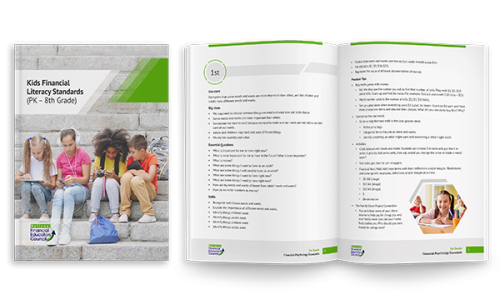
Financial Literacy Standards for Kids (Kids PK through 8th Grade)
In collaboration with education leader Heidi Jacobs, the NFEC created these financial literacy standards to define learning goals and educational targets for optimal child financial education. Guided by strong pedagogical theory, the standards ensure that instructional targets are age- and developmentally-appropriate and that lessons can be effectively scaffolded. Standards represent five sections based on topic areas in the NFEC curriculum.

Standards for Financial Education Instructors
The NFEC teamed with the well-known Danielson Group to develop the first and only national standards for financial educators – The Framework for Teaching Personal Finance – to define optimal educator skill sets and performance levels. The framework also identifies the financial educator responsibilities empirically proven to produce highest gains in participant test scores. This framework is used in all 50 states, including Colorado.