
Colorado Financial Literacy Statistics
The Colorado Financial Educators Council (CFEC) routinely gathers and reports data that characterize the financial wellness of Colorado residents. On this webpage, the statistics are maintained on a regular basis to ensure that they remain current and up-to-date. The Colorado Council offers these data to support advocacy and implementation of financial literacy legislation – informing policymakers, research, community groups, and interested individuals alike. The CFEC’s objective in presenting these statistics is to help advance the financial wellness movement’s agenda.
Cost of Financial Illiteracy Survey
Colorado reports that a lack of financial knowledge carries a high cost, according to this 2021 survey. Participants across the state responded to the single question: “During the past year (2021), about how much money do you think you lost because you lacked knowledge about personal finances?” The results are shown below. Interestingly, almost 9% of survey respondents believed they had lost $10,000 or more in the past year due to financial illiteracy (percentages are rounded).
Cost of Financial Illiteracy
$0 – $499
$500 – $999
$1,000 – $2,499
$2,500 – $9,999
$10,000 +
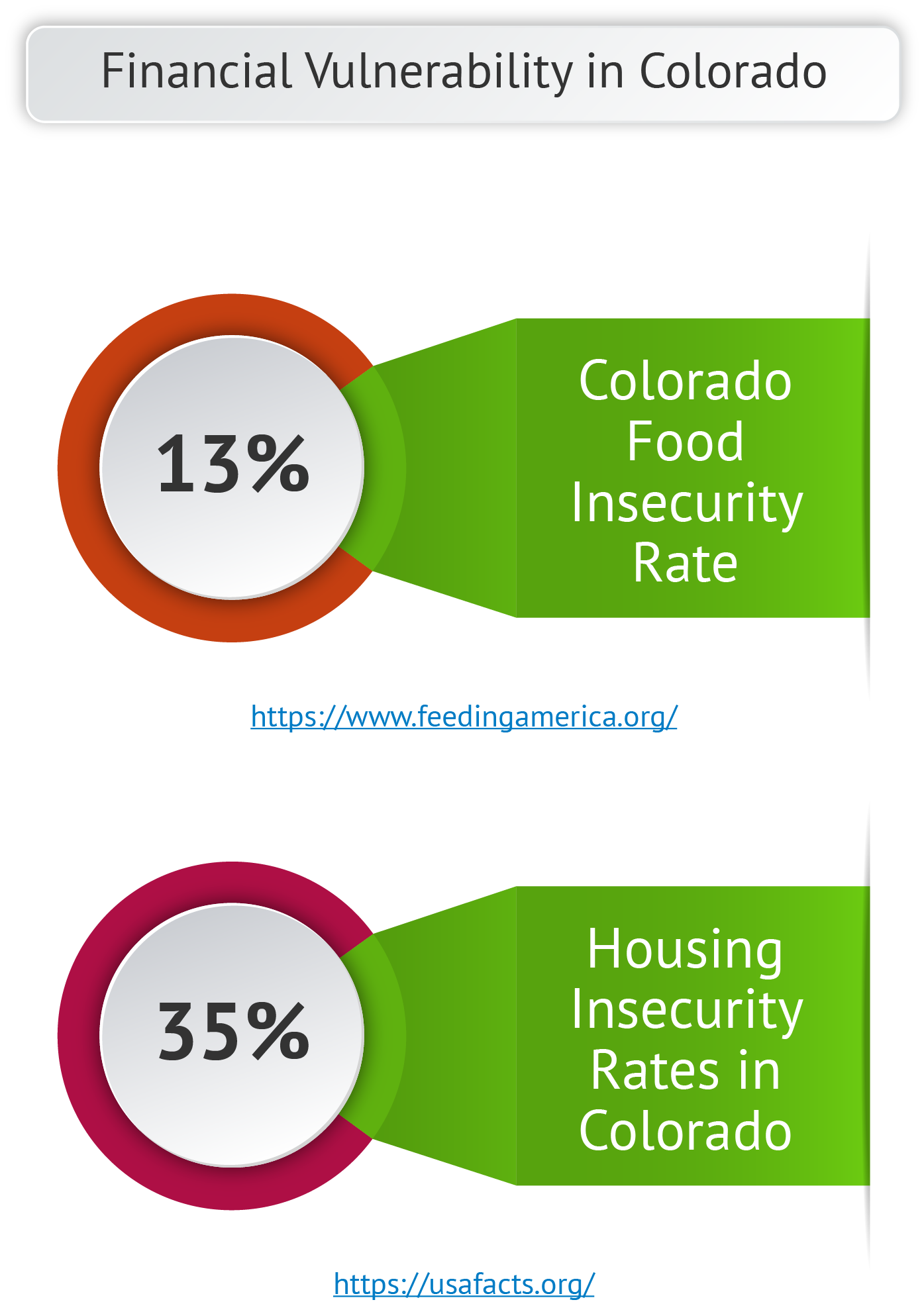
According to the latest report from Feeding America, nearly 745,000 residents of the Centennial State are experiencing hunger today – with 172,540 of those people being children. That’s one out of every eight individuals in Colorado facing food insecurity. Of the households that receive food assistance through the Supplemental Nutritional Assistance Program (SNAP), 42.8% have children living in the home.
Housing insecurity also poses a particular issue for Coloradans. The World Population Review reports that, as of 2025, Colorado had a total unsheltered population of 18,715 and a homeless rate of 32 per 10,000 residents, ranking the state 9th in the U.S. for that metric. The metro area of Denver – Colorado’s largest city – is particularly hard-hit by this problem, with the number of homeless individuals increasing by 86% since 2019 and 12% since 2024, according to the Common Sense Institute. The National Alliance to End Homelessness identifies lack of deeply affordable housing as the top cause of homelessness in 2025, followed by rising costs, wage stagnation, and failing support systems. In addition, USAFacts states that at total of 34.9% of all households were cost-burdened, meaning more than 30% of household income went towards housing expenses.
Financial Situation Data
Debt Load Rates
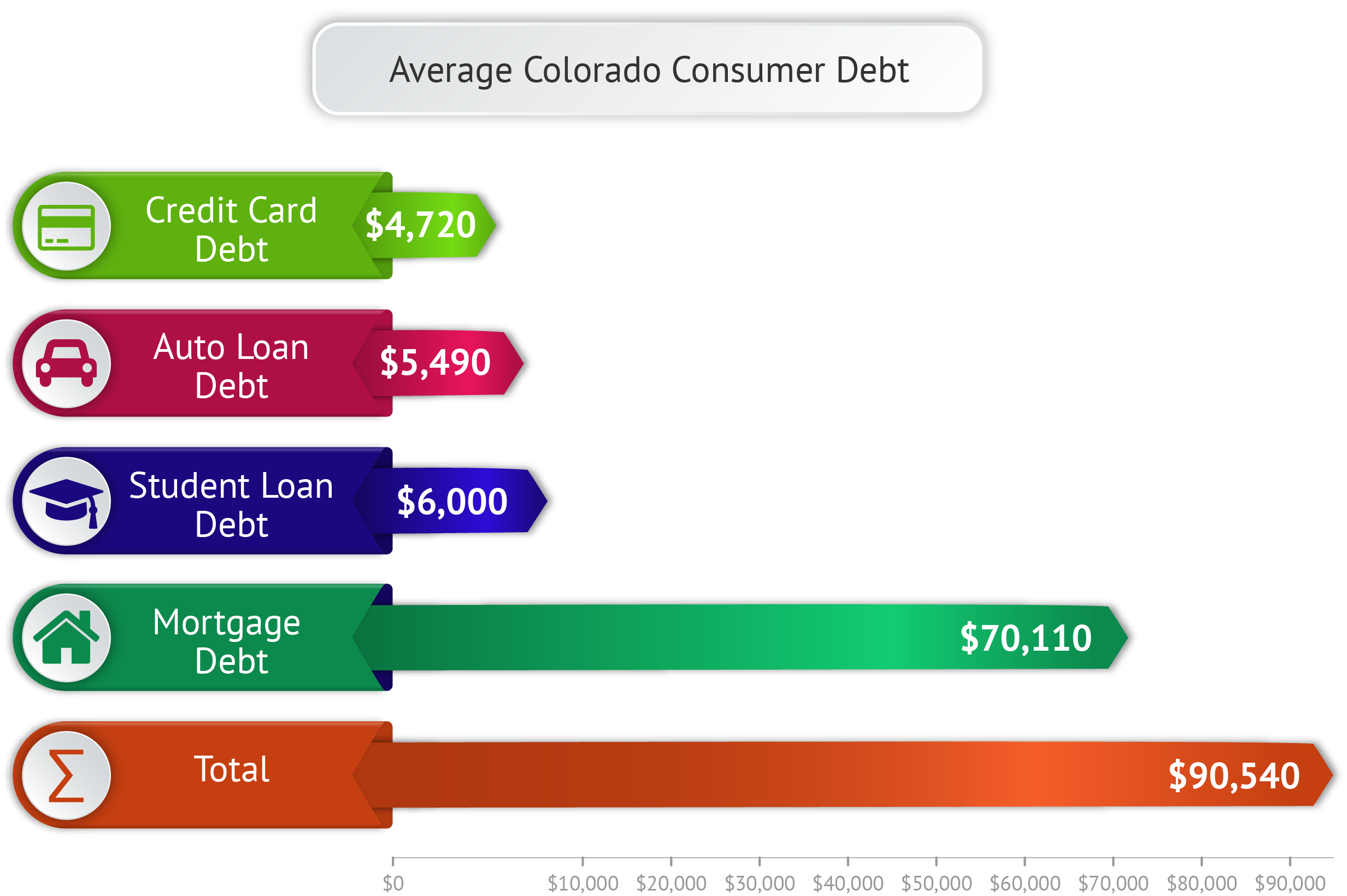
In terms of total household debt, Colorado’s average per household ranks second highest in the nation in 2024 at $90,540, according to the World Population Review. That burden is broken down into averages of $5,490 in auto loan debt; $4,720 in credit card debt; $70,110 in outstanding mortgages; and $6,000 in student loans.
Taking a closer look, other data indicate that the average credit card debt per cardholder – rather than per household – is even higher, at $6,996 according to a 2025 report by TransUnion described in SoFi’s Lantern publication. And Experian reports that Coloradans have the highest average total payment for all their debts in the nation, at $1,558 a month.
Personal Credit Score
Using end-of-year 2024 data from the credit reporting company Experian, Business Insider indicates that average FICO credit scores in Colorado are fairly high compared to the rest of the nation – calculated at 731 as opposed to the 717 national average.
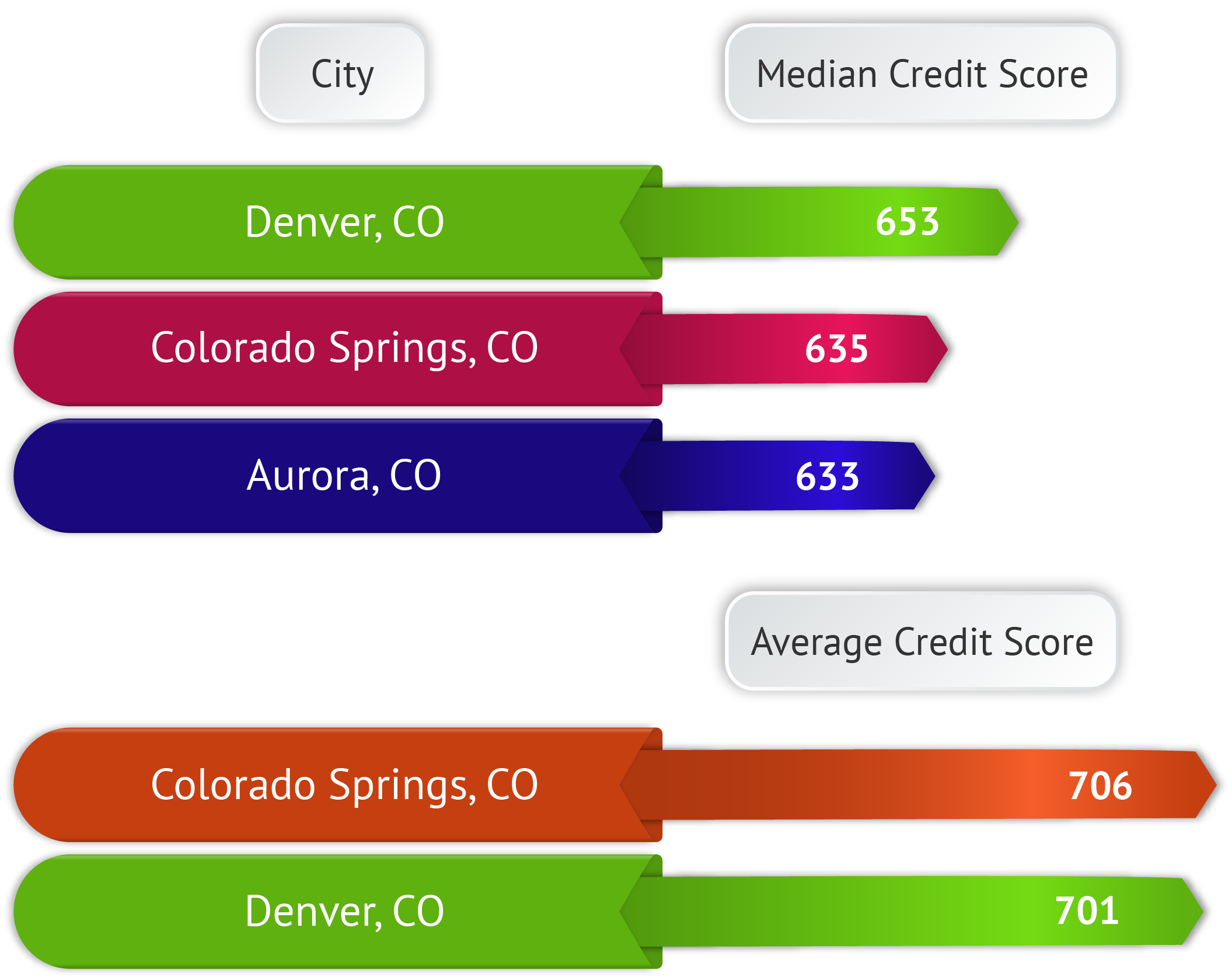
The median credit scores of three mid- to large-sized cities in Colorado according to WalletHub, and the average credit scores of two of those cities are shown at right.
A large difference between the median and average score can mean that while the majority of the population has credit scores at or below the median, a smaller number of residents have exceptionally high credit scores, which pulls the average up. This has not been assessed specifically for these cities, but is common in statistics.
Colorado Financial Literacy Legislation & Educational Statistics
The National Education Association (NEA) gathers state-level data on operating elementary/middle/high schools, enrollments, and educational staff across the U.S. Their most recent report (2023-2024) indicates that Colorado had 185 public school districts operating that academic year, with 881,464 students enrolled. These districts employed 69,437 instructional staff, for a pupil-to-teacher ratio of 12.7.
In its 2025 Regular Session, the CO General Assembly passed HB25-1192, the Financial Literacy Graduation Requirement Act for Pre & K-12 schools, and Governor Jared Polis signed the legislation into law in May 2025. This bill mandates that students must complete a course that incorporates all the financial literacy standards developed by the Colorado department of education as a requirement for high school graduation. The act also stipulates that, during their graduation year, all students must have exposure to federal financial aid eligibility tools and net price calculators; and the opportunity to practice filling out a free application for federal student aid or the Colorado application for state financial aid. This legislation goes into effect during academic year 2027-2028.